Lipa na M-Pesa Integration
Safaricom dictates the contract. You build around it. Event-driven by design.
The integration problem
Most payment providers adapt to your API. M-Pesa C2B doesn't. Safaricom pushes two callbacks: a validation request before funds move, then a confirmation once the money is collected. That second call is essentially a notification: the funds are already gone. There's no retry, no second chance.
That's why the integration needed its own dedicated gateway, built for resilience from the ground up. Not bolted onto the billing system, but sitting in front of it, absorbing Safaricom's contract and translating it into something the rest of the platform could handle reliably.
This integration is inspired by the real-world C2B Paybill pattern M-Pesa api specifically.
Architecture: design first, then build
A full technical assessment was produced before writing a line of code, TOGAF-inspired in structure, covering baseline architecture, target topology, gap analysis, ADRs, NFRs, security model, resilience strategy, and testing approach. The document went through 7 versions across 6 weeks, including a major architectural pivot from Spring Events to RabbitMQ and the Outbox Pattern.
The document was also written to serve as context for AI-assisted development. Without sufficient specification, AI tools interpret gaps freely rather than following the intended design decisions. The level of detail here was deliberate. Development took only 3 weeks: AI-assisted coding guided by the specification, and the Utility Account System used as a proven architectural template.
The load and soak tests validated the architecture in production. The post-implementation assessment captures deviations from the original design and lessons learned.
System topology
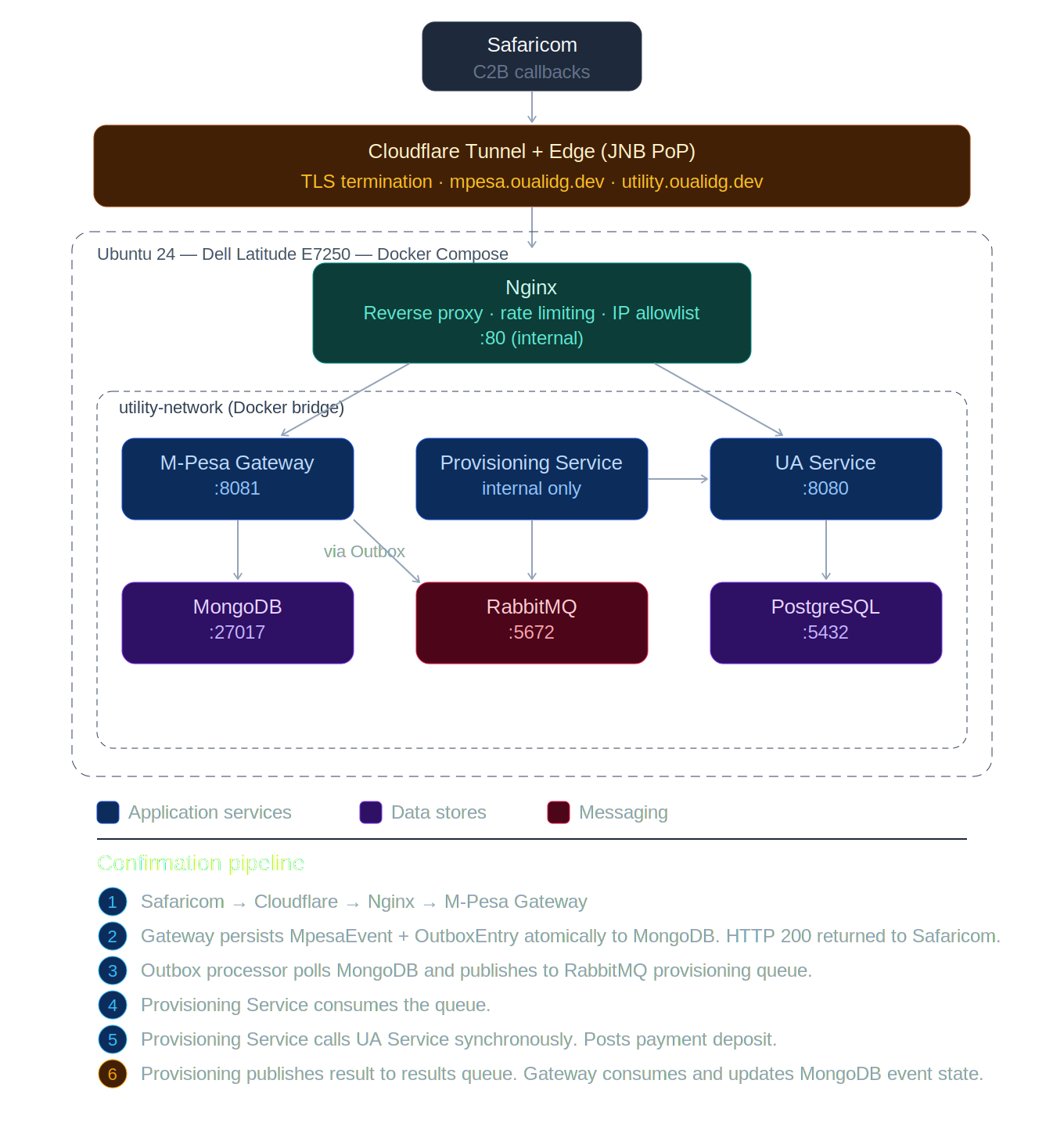
The integration adds two new microservices, a message broker, and a dedicated event store to the existing stack, each with a clear ownership boundary:
M-Pesa Gateway
Dedicated microservice that terminates the Safaricom C2B integration. Receives validation and confirmation callbacks, persists events and outbox entries to a dedicated MongoDB instance, and publishes provisioning requests to RabbitMQ. Returns HTTP 200 to Safaricom immediately after durable persistence, before downstream processing begins. Does not perform billing logic.
Provisioning Service
Stateless microservice that consumes provisioning requests from RabbitMQ, submits payment deposits to the Utility Account Service via its existing API key auth, and publishes results back. Built for resilience: circuit breaker, retry with backoff, and timeout protection on all UA Service calls. Fully reusable across future payment gateway integrations.
Utility Account Service
The existing billing system. Receives payment deposits from the Provisioning
Service exactly as it would from any other provider. Idempotency via
TransID (Safaricom's unique transaction identifier) prevents
duplicate postings on retry.
RabbitMQ
Decouples ingest from processing. Two queues with dedicated DLQs:
provisioning.queue for payment execution requests and
results.queue for processing outcomes. Dead-letter exchange
routes exhausted messages to DLQs after retries, for operator visibility
rather than silent failure.
135 tests across both services covering unit, integration, end-to-end pipeline, HTTP client behaviour, retry count, circuit breaker, and manual acknowledgement scenarios.
Stack
Observability
Every payment flowing through this gateway is traceable end-to-end via Grafana. The dashboard below shows live confirmation and validation throughput, latency, event states, and outbox health for the M-Pesa pipeline.
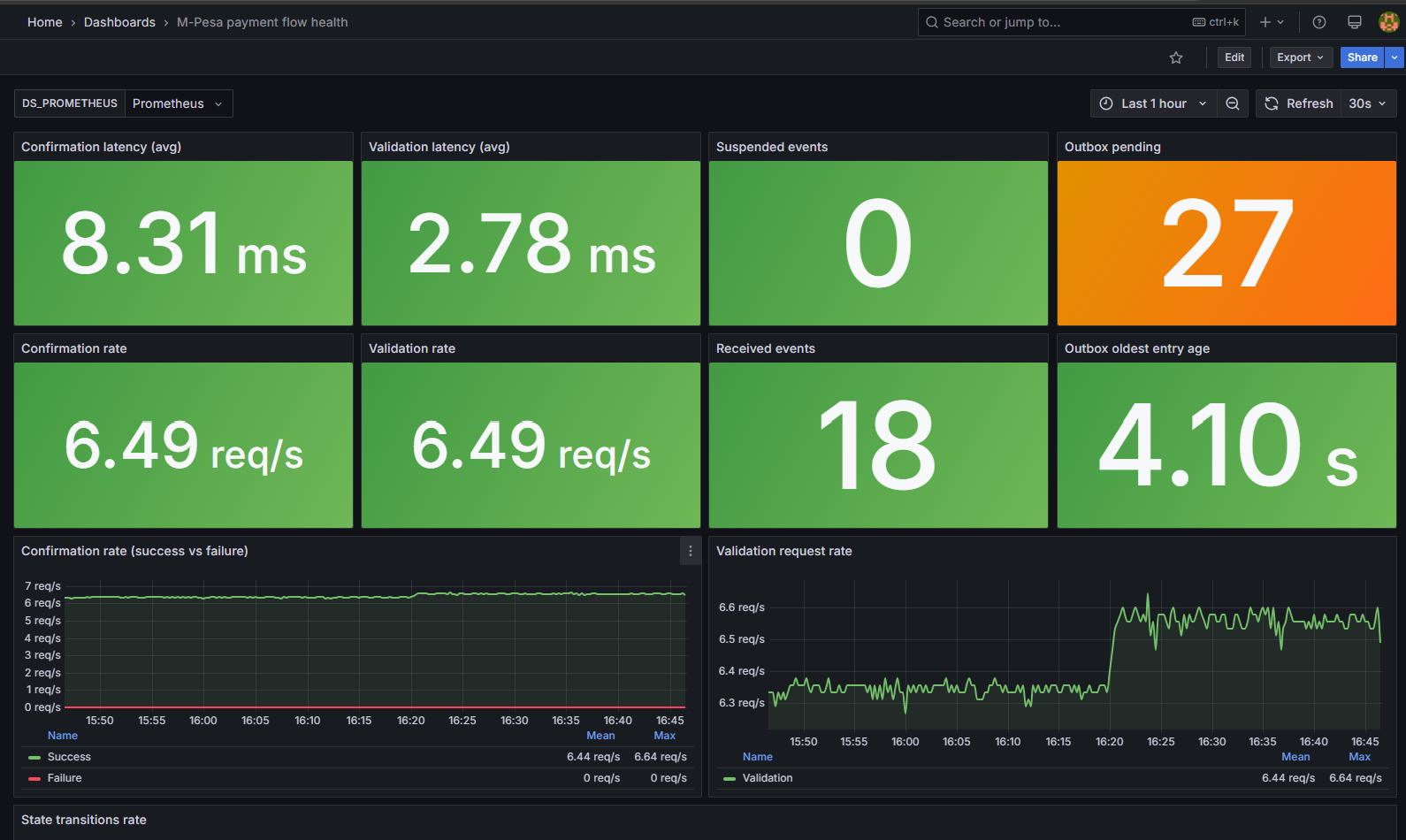
Live dashboard — current traffic from continuous soak testing. The 2.8M-event figures above are from the original load test; this reflects ongoing operational monitoring.
Key design decisions
Outbox Pattern for reliable event publishing
The classic dual-write problem: writing to MongoDB and publishing to RabbitMQ in two separate operations means either can fail independently, leaving the system in an inconsistent state. The Outbox Pattern solves this by writing the MpesaEvent and the OutboxEntry atomically in a single MongoDB transaction. A separate OutboxProcessor polls and publishes to RabbitMQ using a lease-based state machine (PENDING, PROCESSING, SENT, FAILED) to guarantee exactly-once publish semantics even under JVM crash or concurrent processor scenarios. If RabbitMQ is unavailable at callback time, the event is captured durably and published on recovery.
Post-check before retry
Before retrying a failed payment call, the Provisioning Service checks whether the previous attempt actually posted by querying the confirmation endpoint. If a receipt exists, it's returned immediately without re-posting, avoiding unnecessary retry attempts when the UA Service already processed the request.
Two-call flow: validate then confirm
Validation arrives before funds move and requires a response within 8 seconds. This path is handled synchronously with circuit breaker protection. The confirmation arrives once funds are collected and is acknowledged immediately, with processing completing through the async pipeline. Both are Safaricom-initiated callbacks on their schedule.
End-to-end MDC tracing
Every request carries a correlationId and the Safaricom
TransID through all four services via SLF4J MDC. A single
payment can be traced end-to-end across Nginx, M-Pesa Gateway, RabbitMQ,
Provisioning Service, and UA Service logs without any additional tooling.
Try the API
The M-Pesa Gateway Swagger UI is live. You can simulate a full C2B callback flow directly from the browser.
1. Open Swagger UI
No login required. The callback token is pre-filled on all endpoints.
2. Simulate a validation callback
Call POST /api/v1/validation. Use this sample payload with a valid
account number or customer ID as BillRefNumber. Grab one from the
Utility Account UI
(log in with admin / admin).
{
  "TransactionType": "Pay Bill",
  "TransID": "NLJ7RT61SV001",
  "TransTime": "20250607120000",
  "TransAmount": 1500,
  "BusinessShortCode": "600123",
  "BillRefNumber": "YOUR_ACCOUNT_OR_CUSTOMER_NUMBER",
  "InvoiceNumber": "",
  "OrgAccountBalance": 0,
  "ThirdPartyTransID": "",
  "MSISDN": "254712345678",
  "FirstName": "John",
  "MiddleName": "",
  "LastName": "Doe"
}
3. Simulate a confirmation callback
Call POST /api/v1/confirmation with the same BillRefNumber,
BusinessShortCode, and a unique TransID. The gateway
persists the event to MongoDB and publishes it to the provisioning pipeline.
4. Verify the payment
Open Utility Account Swagger
and select Admin API from the Select a definition dropdown (top right).
Under the Authentication section, call POST /api/auth/login
with admin / admin
(the X-Auth-Mode: bearer header is pre-filled).
Copy the accessToken from the response, then click Authorize
(lock icon, top right) and paste it as a Bearer token.
Under the Reports section, call Search payments
with your customer ID. The most recent entry should show your TransID
as paymentReference and MPESA as the provider.
5. Trace the payment in Grafana
Copy the x-correlation-id from the confirmation response headers in Swagger.
Open Grafana
(log in with admin / admin), go to
Explore, select Loki as the datasource,
and run:
{service=~"mpesa-gateway|provisioning-service|utility-account"} |= "YOUR_CORRELATION_ID"Enable Unique labels to see which service each log line came from. Set Display results to Oldest first to follow the payment journey in sequence -- Gateway ingestion, RabbitMQ publish, Provisioning processing, UA Service deposit, and final state transition.